
If you were asked to guess among the world’s most popular flavours, there’s every chance vanilla crosses your mind. Its sweet, familiar aroma is comforting, and real-world data proves it— surveys worldwide have constantly put it as the leading ice cream flavour and among the top milk/milkshake flavours. Thanks to its complex flavour profile, vanilla graces many diverse products, from cookies to perfumes—it’s tough to keep count. Correspondingly, the market for vanilla-based products is growing, giving us innovative food and beverage creations that are increasingly sustainable and healthy.
For something so famous, what is vanilla really? Capturing the journey from a plant to a bottle on a shelf is a fascinating topic. The blog will outline how vanilla flavour is made, exploring the plant’s harvest and the vanilla extraction process to what happens to the leftovers at the end of production. We also look at the history of vanilla, discuss the different types of vanilla flavours, and share a surprising insight into what pure vanilla tastes like.
A History of Vanilla
The origin of the universally loved spice is the historical Mesoamerica region. While the oldest reports of vanilla use go back to the pre-Columbian Maya, who utilised vanilla as a cacao-beverage spice, the Totonac people of Papantla in eastern Mexico were likely the first to cultivate vanilla. By the early 1500s, vanilla was taken away from Mexico for the first time on ships to Spain as a perfume; it took Hernán Cortés’ expedition in 1519 for the Spanish to learn its value as a flavour. Vanilla was reintroduced to mainland Europe in beverage form, and people began to add it to various recipes over the decades. By 1700, vanilla had spread across the continent and was being used in ice cream and confectionery!
Vanilla beans were imported from Mexico after their initial introduction, and the plant was cultivated in botanical gardens in France and England but frustratingly failed to yield fruits. It took centuries to report that only a non-European insect (the Melipona bee; a later study says it might have been a different bee) was the plant’s natural pollinator. Luckily enough, a difficult hand-pollination method was discovered on the island of Réunion, and the technique spread to nearby Madagascar (the leading vanilla producer today). Vanilla found its way to other tropical regions and beyond, capturing people’s senses with its uniquely robust aroma and taste. Global fame and commercial production followed—demand has since exponentially grown, leaving it prized as one of the world’s most expensive spices.
Growing Vanilla Beans
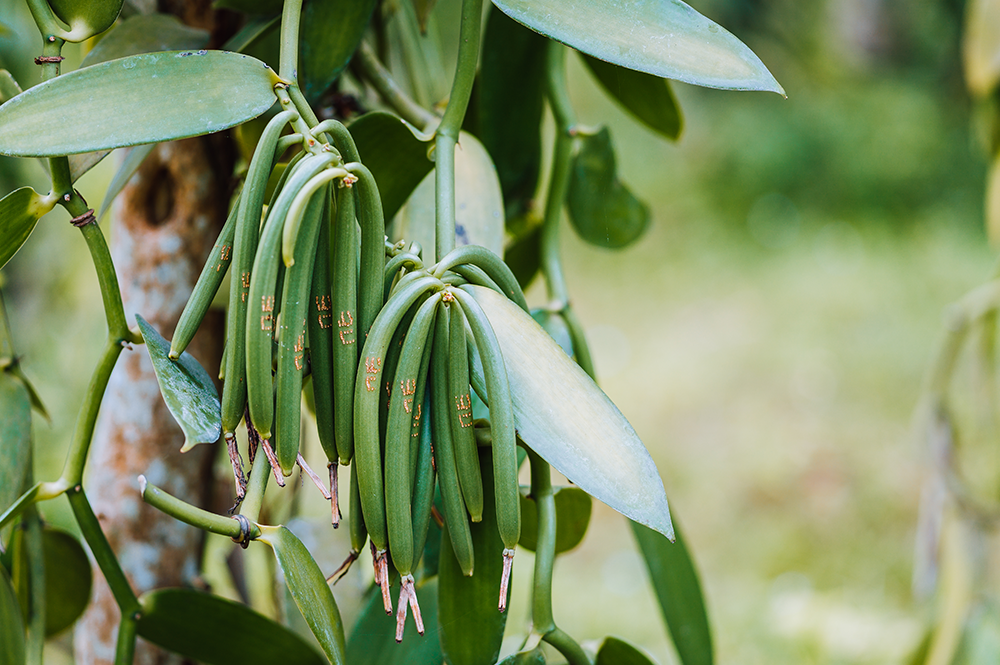
At the same time, vanilla remains challenging: Growing vanilla beans is still arduous and demands a lot out of the entire production, not least of all hand pollination. The growth process consists of:
Cultivation
Vanilla orchids thrive in tropical regions with dappled sunlight. They are cultivated in plantations and trained to climb supports. To start things, a long, thin needle to position the pollen between the anther and stigma helps accomplish pollination.
Harvesting
Harvest occurs by individually picking out fully grown vanilla beans from the flower just as they ripen. The beans are odourless at this stage and show a colour change.
Curing Process
It involves four stages.
Vanilla Extraction Process
Selecting the Vanilla Beans
The beans are evaluated up until their conditioning. Beans that are cured properly and of a higher grade are picked for their quality. Suppliers should provide the necessary details, from the point of cultivation to the completion of curing.
Extraction Process
The solvent method is the most common and straightforward way to extract vanilla. The chosen vanilla beans are shifted to an extraction tank, and alcohol is added gently throughout, extracting flavour compounds from the beans. Water is then added to draw aqueous compounds from the beans and completes the profile of the extract. It’s that simple! The percolation method is similar to the previous method. It consists of spreading a half-to-half ethyl alcohol/water solution over the vanilla beans under vacuum for two or three days. In supercritical CO 2 extraction , beans are ground and charged into the extractor and then fed with CO 2 under high pressure. CO 2 containing the extract is passed into a separator at reduced temperature and pressure, causing the extract to precipitate. This method assures a high-potent output.
Concentration and Filtration
With the end in sight, the extract is tested for the right concentration, as noted by its ‘fold’. Lastly, extracts are filtered by various techniques to ensure the liquid is free of possible contaminants. Sometimes, it’s the seeds from the agitated beans that fall through and need clearing.
Byproducts and Sustainability
The leftover byproduct(s) can be repurposed if possible. For example, filtered material like seeds can be used for other applications. It’s no secret that manufacturers are pivoting towards more sustainable operations and are searching for smarter ways to process what remains at the end.
Vanilla Flavouring vs Vanilla Extract
Vanilla products are so vast, it can be a chore to figure out what the right one is for a particular purpose. Here’s a simple guide:
Pure Vanilla Extract
Soak vanilla beans in alcohol, and voila! Pure vanilla extract, which should have a minimum of 35 per cent alcohol, is used in cooking and food manufacturing (as a flavouring agent or adjuvant). It lends a characteristic ‘vanilla’ flavour to ice cream, cookies, custard, and much more while enhancing other existing flavours. The extract has an intense and complex profile made of hundreds of subtle notes. It also ages really well—it becomes more mellow and flavourful over time, shedding any bitterness it may have.
These should be the go-to vanilla flavour choice for all applications. Unfortunately, the vanilla shortage amidst increasing demand makes it a prized and exceptionally costly commodity, with some going for over USD 20 for a 120 ml bottle.
Imitation Vanilla
Thankfully, we won’t have to wait for the world’s vanilla supplies to run out. Imitation or synthetic vanilla extract is derived from lab-made vanillin. The vanillin here can be synthesised from clove or guaiacum and even wood pulp! The majority of the vanilla extract used in the world is imitation vanilla. It can be easily identified by its in-your-face vanilla flavour and flat notes. Despite that, it is handy and works well for multiple applications.
Vanilla Flavouring
It is merely pure vanilla extract with an ethyl alcohol content of less than 35 per cent by volume.
(For more information on these products and standards for labelling, refer to the FDA guidelines here . 169.175–169.182)
Conclusion
Vanilla’s century-long legacy of being impossible to cultivate freely can be felt to a degree even today! From time-exhausting hand pollination to the meticulous curing and extraction processes, it’s almost like the plant does things the tough way. But, for an ingredient that is struggling to meet demand, every step of how vanilla flavour is made is critical. Whether it’s natural vanilla that offers complex, rich flavours or synthetic vanilla that solves the scarcity problem, tracing their origins and journey to the bottle can give us an appreciation of their value and turn us around to sustainable manufacturing practices.